
Empowering Frontline Workers with AI and Augmented Reality Guidance
Manufacturing is entering a new era of digital transformation. Advances in artificial intelligence (AI), augmented reality (AR), and the Internet of Things (IoT) are reshaping frontline work and laying the foundation for the augmented connected workforce.
Despite rapid advances in AI and automation, many industrial operations still depend heavily on human hands. In fact, 72% of factory tasks are performed by people. However, only 23% of frontline workers say they have the tools they need to be productive.
This raises a critical question: How can we make technology work for the people who keep operations running?
To answer that question, organizations must rethink how people and technology work together. Augmented intelligence combines the best of both, connecting workers with insights, guidance, and tools that empower them to work smarter, adapt faster, and perform with greater confidence.
From AI-driven analytics to AR-guided work instruction platforms, today’s augmented intelligence tools are helping companies close productivity and skills gaps throughout their operations. Let’s take a closer look at how organizations are using augmented intelligence to build a connected workforce and explore how operator guidance platforms like LightGuide combine AR work instructions with AI to empower frontline workers.
IN THIS ARTICLE
The Rise of Augmented Intelligence in Industry
The Difference Between Artificial Intelligence and Augmented Intelligence
How to Connect Augmented Intelligence to Frontline Performance
Examples of Augmented Intelligence in Industry
The Rise of Augmented Intelligence in Industry
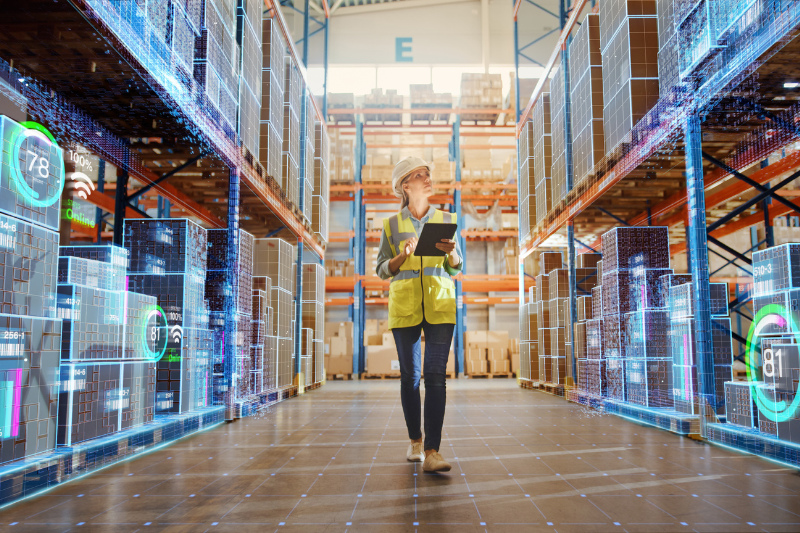
Industrial enterprises have spent decades collecting data, automating processes, and digitizing operations to lay the foundation for smarter, more connected facilities. But as labor shortages, production challenges, and supply chain pressures persist, it’s clear automation alone isn’t enough.
According to IBM’s Institute for Business Value, we’re entering the “age of the augmented workforce,” a new era of digital transformation where human-machine partnerships deliver exponential business value.
That transformation is already reshaping priorities across the industry.
According to Deloitte’s 2025 Smart Manufacturing and Operations Survey, more than a third (35%) of respondents cited adapting workers to the “Factory of the Future” as a top concern, including “equipping them with the skills and tools they need to harness the full potential of smart manufacturing and operations.”
To stay competitive, companies must connect digital intelligence with the people who keep operations running, enabling transformation where it matters most.
Artificial Intelligence vs. Augmented Intelligence
Unlike artificial intelligence, which aims to automate decision-making, augmented intelligence works alongside people, delivering timely insights that help workers adapt quickly and work more efficiently.
- Automation: Machines doing more work
- Artificial intelligence: Systems making decisions independently
- Augmented intelligence: People empowered to do better work with intelligent tools
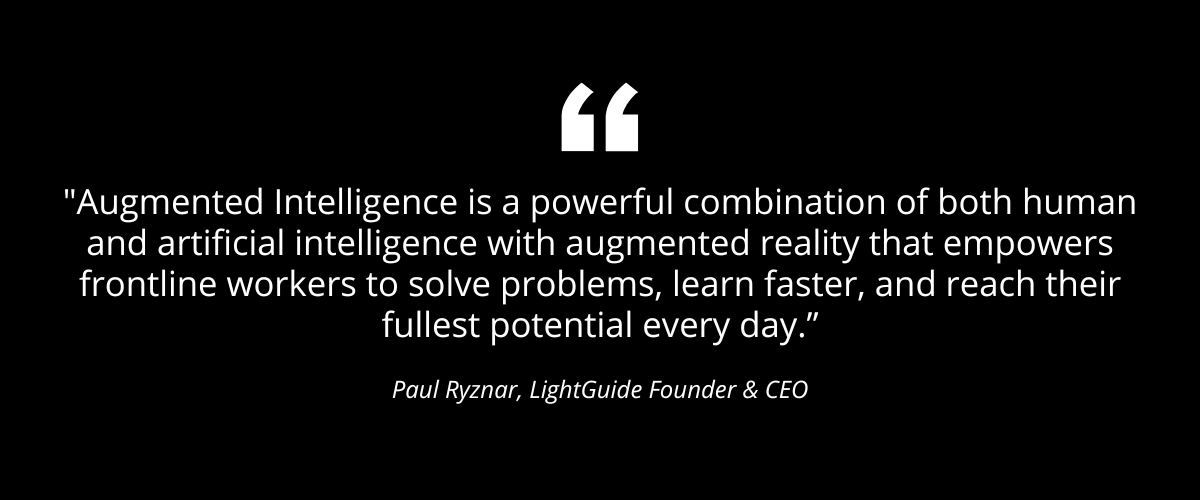
Connected worker technologies, such as AI, AR, and IIoT-enabled tools, create a foundation for augmented intelligence, connecting people, data, and systems. Of these, augmented reality offers the most practical path to implementing digital intelligence in industrial and technical environments, from factory floors to data centers.
- AI and Machine Learning provide real-time insights that inform and adapt workflows.
- AR delivers visual guidance and validation to enable operators in the moment.
- IoT connects machines, systems, and sensors for continuous monitoring and feedback.
Augmented Reality: The Bridge Between Augmented Intelligence and Frontline Operations

At its core, augmented reality is one of the most practical ways to deliver augmented intelligence to frontline workers in industrial environments. It serves as a bridge between digital intelligence and physical execution, transforming complex information into hands-on guidance.
AI powers the “intelligence” behind augmentation, feeding AR with data and error detection logic that can be used to guide, validate, and improve frontline performance in real time.
LightGuide combines AI and AR into a single platform, transforming standard operating procedures into intelligent, adaptive workflows that deliver real-time insights and visual feedback. This helps frontline workers perform tasks with greater precision, speed, and confidence.
With LightGuide, companies can:
- Turn digital twin simulations or bill of process data into AR work instructions
- Deliver real-time visual guidance to frontline teams
- Detect and prevent errors in real time with AI-powered machine vision
- Capture key operational data for traceability and continuous improvement
This convergence of AI and AR gives organizations a practical path to deploying intelligent, human-centered automation.
Examples of Augmented Intelligence Across Industry
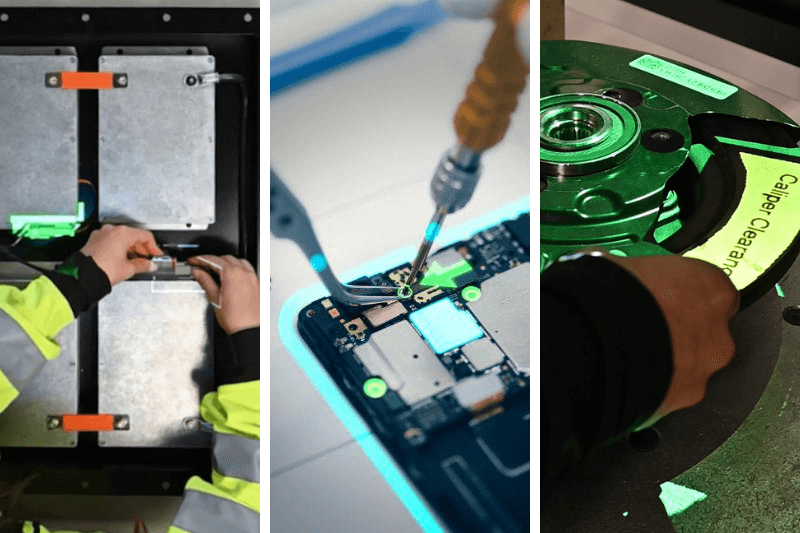
Across factories, fulfillment centers, and data centers, the need for this kind of intelligent collaboration has never been greater.
On any given shift, frontline teams juggle diverse product configurations, rapid changeovers, and tight production timelines. In moments like these, real-time feedback and intelligent guidance aren’t just nice to have—they’re essential. That’s why forward-thinking companies are using augmented intelligence to give workers the information and feedback they need, exactly when they need it.
Let’s explore how companies are combining augmented reality with AI-driven intelligence to:
- Accelerate onboarding and reduce turnover
- Standardize SOPs and enforce process adherence
- Improve cycle times and throughput
- Reduce errors and rework
- Boost engagement and job satisfaction
- Enhance safety and accessibility
- Capture data for better traceability and continuous improvement
1. Using Augmented Intelligence to Improve Training and Workforce Development
The impact of AI and augmented reality on workforce readiness is profound.
Traditional training programs can take weeks or even months to bring workers up to speed. With AR training, employees learn up to 70% faster. According to research from the World Economic Forum, businesses have improved training effectiveness by up to 80%.
AR delivers interactive, hands-on learning experiences that simulate real-world scenarios. As a result, workers gain practical, on-the-job experience in a controlled environment. Every employee is trained on the same best practices from day one, and companies can upskill and redeploy workers quickly to meet changing production demands.
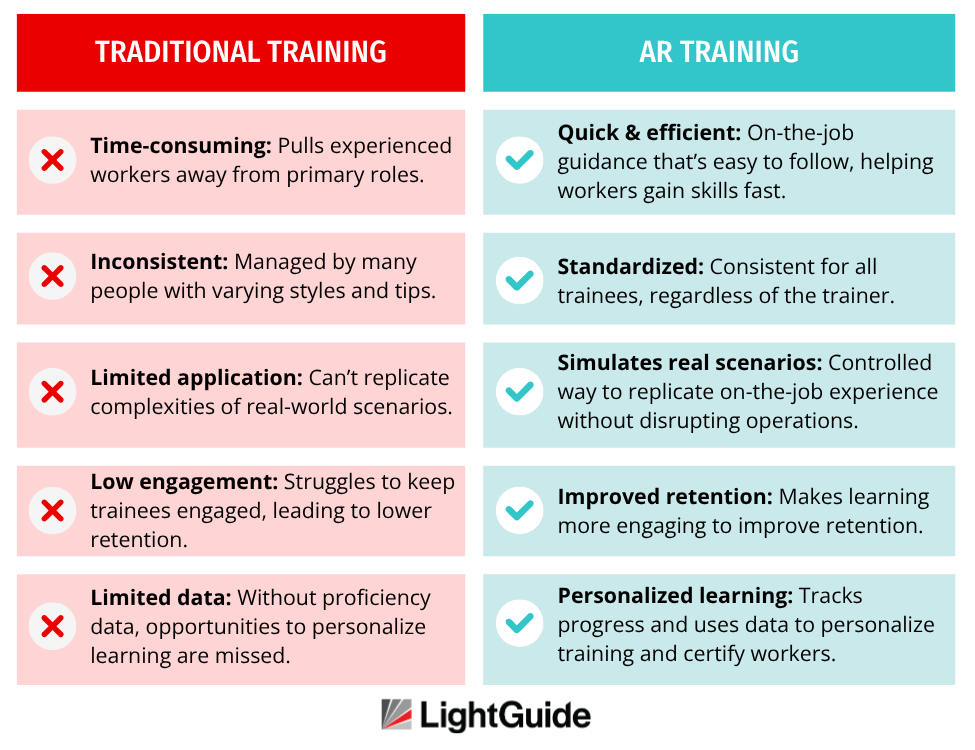
When combined with AI, companies can use AR training to:
- Personalize training programs and adapt the pace to each worker’s needs.
- Gather performance insights, identify areas for improvement, and recommend additional practice on specific steps.
- Track progress, measure proficiency, and certify workers once specific objectives are achieved.
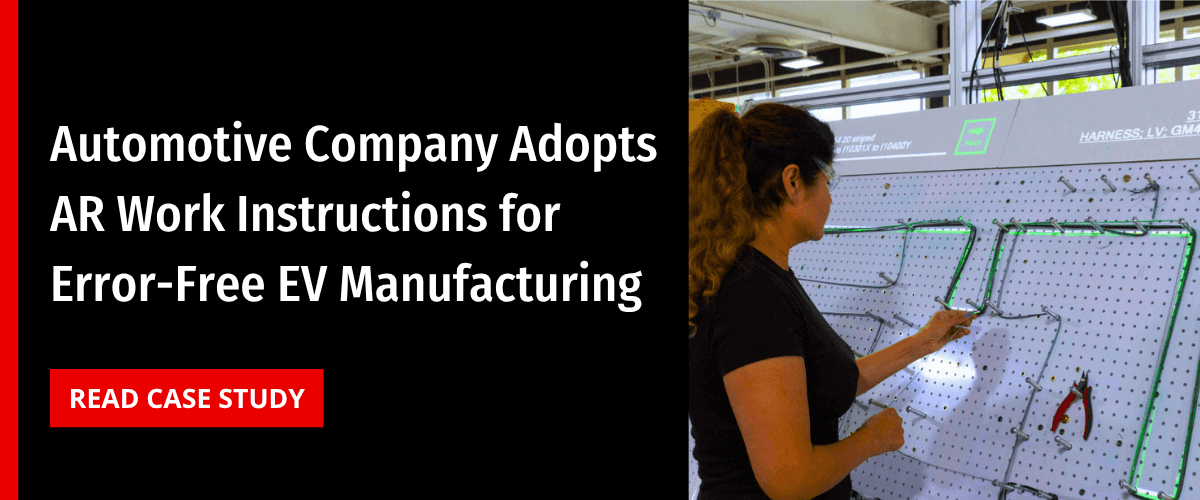
Case Study: Using AR work instructions, this EV manufacturer optimized training and assembly workflows, reducing cycle time by 50% and training time by 75%. Discover how here.
2. Increasing Productivity and Efficiency with Augmented Intelligence
The benefits of augmented intelligence extend beyond training, delivering measurable gains in efficiency.
Factories, fulfillment centers, and data centers are all ripe for transformation, as frontline work often involves intricate processes that are complex and prone to error.
Workers must manage constant variation and remember intricate task sequences, while simultaneously meeting strict cycle time and throughput targets. Under that pressure, even experienced workers are prone to mistakes.
With AR, that complexity becomes easier to manage.
- Intuitive: Rather than relying on manuals or tribal knowledge, workers receive intuitive, step-by-step visual guidance, ensuring they have the right information when and where they need it.
- Streamlined: AR shows the most efficient way to complete each task, eliminating non-value-added work.
- Connected: Each step is linked to real-time data and system feedback, ensuring seamless handoffs and uninterrupted workflow.
AI takes this one step further, analyzing workflow data to identify inefficiencies, optimize procedures, and ensure compliance with established standards. With LightGuide AR, organizations can:
- Generate AR work instructions from digital twin simulations or bill-of-process data.
- Minimize authoring time for new variants and standardize processes across sites.
- Share real-time production data with MES and ERP platforms to pull part details and dynamically adapt workflows, delivering part-specific AR guidance based on serial numbers and variants.
The result? Faster execution, shorter cycle times, and less downtime between changeovers. In fact, manufacturers that have adopted AR-guided workflows report productivity gains of more than 50%.
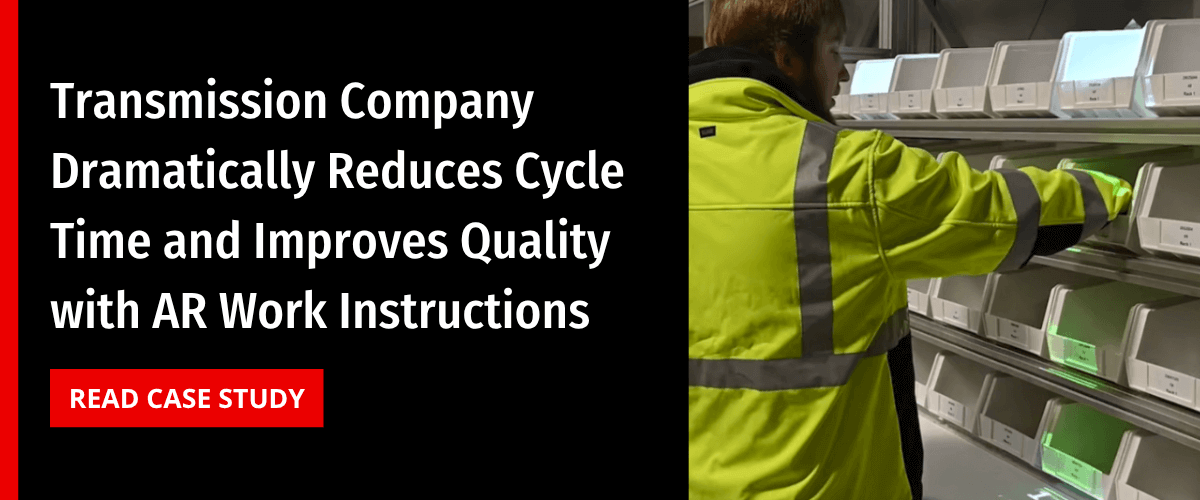
Case Study: After implementing LightGuide on a production line with four workstations and nearly 100 parts bins, this transmission supplier eliminated process confusion, reducing cycle time and improving quality by 100%. Find out how, here.
RELATED ARTICLE: Digital Work Instructions Explained: The Ultimate Guide
3. Improving Quality Control with Augmented Intelligence
This standardized approach ensures products are built the same way across shifts and plant locations.
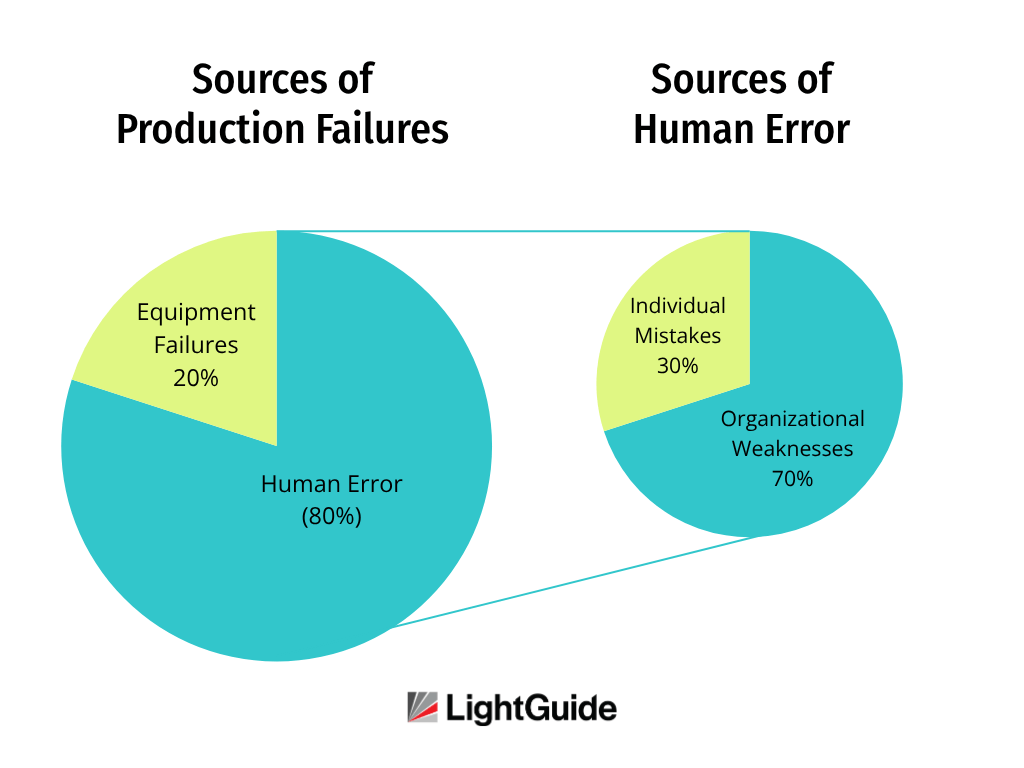
Interestingly, the U.S. Department of Energy’s Human Performance Improvement Handbook found that nearly 80% of mistakes are caused by human errors. Of those, 70% stem from organizational weaknesses rather than individual error. In other words, people don’t fail on their own. Systems fail to support them effectively.
By combining augmented intelligence with AR guidance, manufacturers can close systemic gaps, enforce process adherence, and prevent errors before they occur.
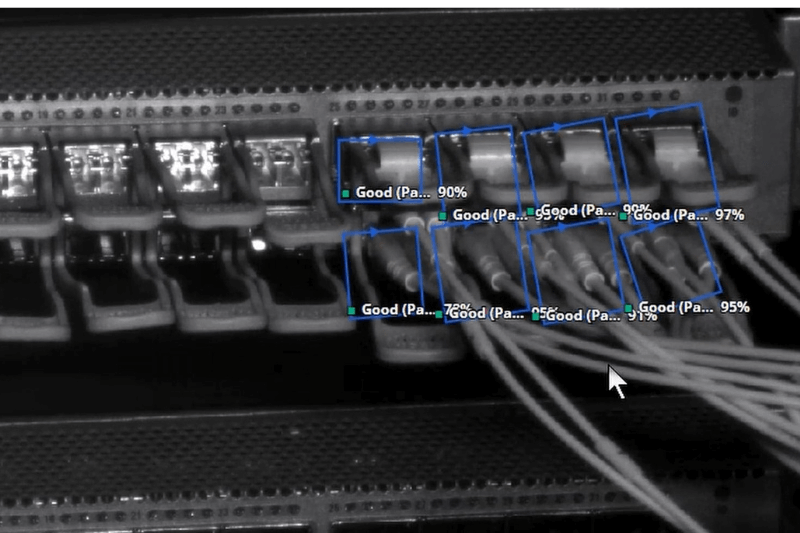
LightGuide’s AR guidance platform transforms quality control from reactive to proactive. Digital work instructions are displayed directly onto the workspace, guiding each step so workers don’t have to rely on memory or interpret complex diagrams. Each action is validated in real time through AI-powered machine vision, confirming accuracy and ensuring consistency across operators, shifts, and locations.
Companies using AR-guided workflows have reported:
- Over 90% reduction in defects
- Fewer missed steps and less rework
- Improved consistency and first-time yield
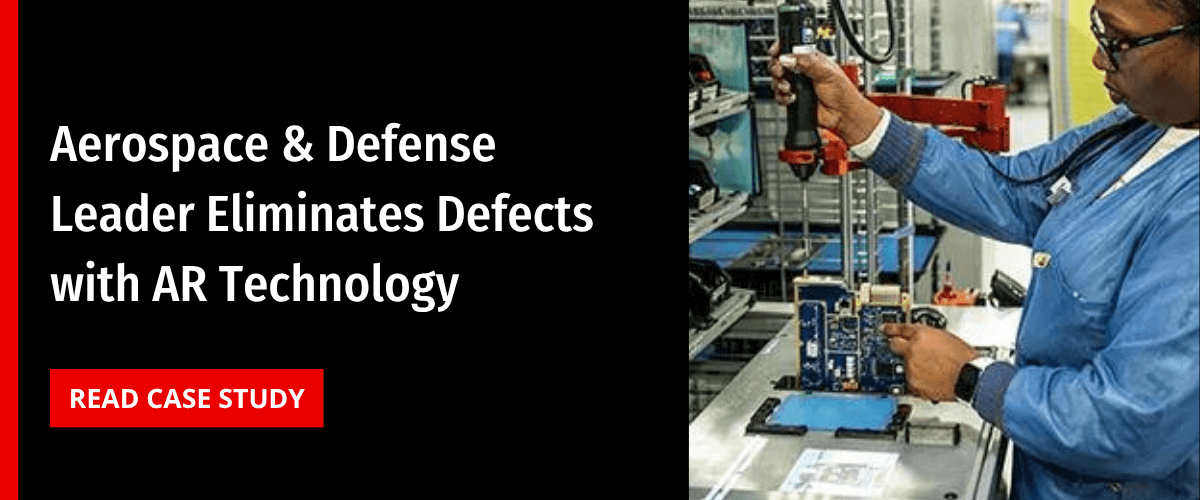
Case Study: Learn how L3Harris eliminated assembly-related defects and changeover per variant by using LightGuide’s projected AR work instructions for guidance and confirmation on high-variation lines. Read the full case study here.
4. Using Data to Improve Augmented Intelligence
In today’s industrial landscape, data is the driving force behind digital transformation. From predictive maintenance to AI-driven analytics, connected systems help companies improve efficiency and stay competitive.
While automated processes are easy to monitor (thanks to built-in sensors and system logs), manual workflows are often a blind spot. As a result, hidden issues can ripple across operations, causing missed production targets, increased defect rates, and wasted resources.
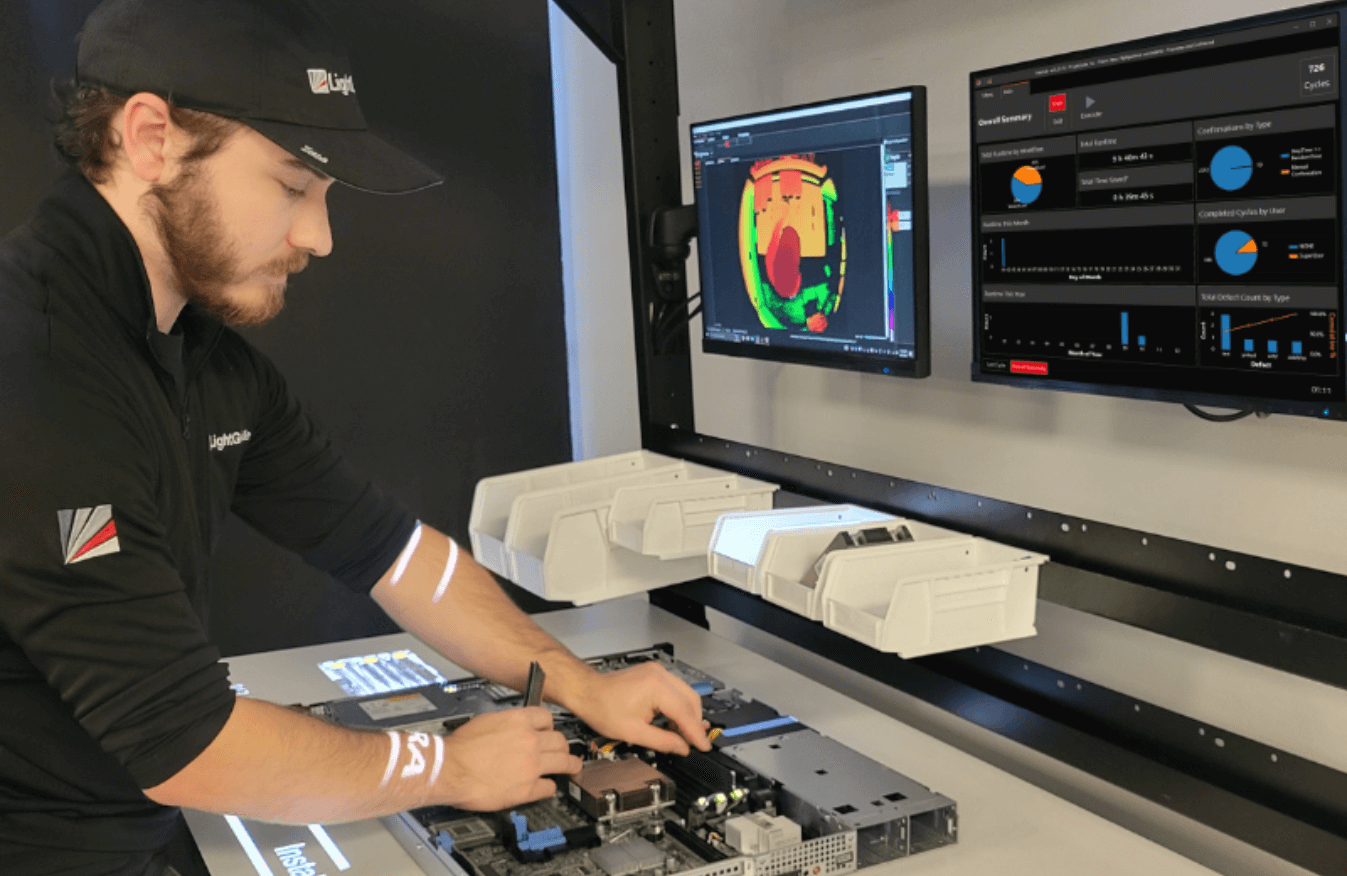
LightGuide’s intelligent AR guidance platform bridges that gap by transforming manual operations into measurable, traceable, and optimizable processes. As operators move through tasks, data is continuously captured and logged, building a digital record of manual operations. This allows teams to:
- Pinpoint bottlenecks and root causes of slowdowns or defects
- Track adherence to SOPs across shifts and locations
- Identify the most time-consuming or error-prone steps
- Analyze workstation layouts and ergonomics to improve safety and performance
- Correlate training effectiveness with cycle times, quality, and rework rates
By connecting execution and analysis in one intelligent loop, LightGuide makes it easier than ever to access, analyze, and act on your manual process data, turning every workstation into a source of insight for continuous improvement.
- Leverage AI-powered analytics to generate clean, reliable datasets and calculate standard step times based on historical workflow data. Built-in anomaly detection excludes outliers, ensuring only the most relevant data informs performance improvements.
- Build custom dashboards to track the metrics that matter most to your operations, from cycle times and quality rates to training impact, operator performance, and more.
- Share production data with SQL servers and cloud analytics platforms, such as Siemens Industrial Edge and Insights Hub, for advanced reporting, data visualization, and AI analysis.
- Capture video recordings of production cycles, embedded with contextual data, to enhance traceability, training, troubleshooting, and analysis.
RELATED ARTICLE: How to Unlock Insights from Manual Process Data to Optimize Operations
5. Augmented Intelligence and the Gamification of Work
The challenge is no longer whether to collect data; it’s how to use that intelligence to empower the people doing the work.
One powerful way to do that is through gamification: applying game-like elements, such as points, badges, challenges, and leaderboards, to everyday tasks as a way to boost employee motivation and productivity.
In industrial settings, gamification helps companies get more value from their people and increase Overall Employee Effectiveness (OEE) by transforming repetitive or mundane tasks into rewarding experiences that improve job satisfaction.
The Science Behind Gamification
Harvard Business Review recently explored the impact of gamification on training, noting that gamified training can significantly improve employee performance.
Atlassian further reinforces the impact of gamification on engagement and morale, citing a Gamification at Work survey in which 89% of employees said gamification made them feel more productive, and 88% said it made them happier at work.
Experts attribute this to behavioral science. In “Gamification at Work: The Neuroscience of Productivity and Enjoyment,” the Wharton Neuroscience Initiative explains that game-like elements activate the brain’s reward pathways, triggering the release of dopamine, which boosts motivation and engagement.
Gamifying the Frontline: Where Augmented Intelligence Meets Engagement
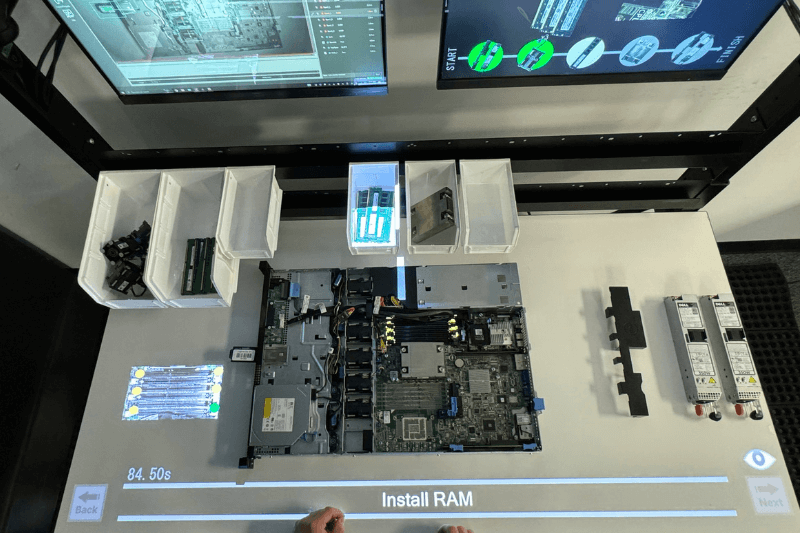
Using AI and AR, companies can integrate game-like elements into workflows.
- Track progress in real-time: AR work instructions transform tasks into interactive experiences or task-oriented challenges. Status bars and timers provide instant feedback, helping workers see their progress, stay on pace, and celebrate achievements as they go.
- Create team leaderboards: Data captured from each task feeds into performance dashboards that encourage friendly competition or collaborative production goals across shifts.
- Deliver personalized training and encourage ongoing skill mastery: Performance data can be used to identify strengths and highlight opportunities for improvement. Operators can complete challenges tailored to personal goals, such as completing a step within a target time or maintaining 100% accuracy over multiple cycles. At the same time, achievement badges can create a sense of progress, mastery, and motivation.
6. Empowering Skilled Individuals to Rejoin the Workforce with Augmented Intelligence
According to research from The Manufacturing Institute and Deloitte, the U.S. manufacturing sector will need to fill nearly 3.8 million jobs by 2033. However, almost half could go unfilled due to a shortage of skilled talent.
To address this challenge, companies are using assistive technologies and augmented intelligence to reduce barriers to employment and expand the labor pool. These tools make work more accessible and create new pathways for individuals to thrive in roles that were previously out of reach.
By simplifying complex tasks and delivering intelligent guidance, AR helps workers gain confidence and independence on the job. Individuals who have been overlooked due to limited experience, language barriers, or physical challenges can now succeed with the right support in place.
Designed for inclusivity, AR supports a wide range of learning and communication needs through:
- Multiple modes of guidance, including adjustable audiovisual support for individuals with sensory processing needs, light sensitivity, or color blindness.
- Multilingual and symbol-based instructions support varying literacy levels and translation into additional languages using AI.
- Ergonomic design and projected AR eliminate wearables and handheld devices, allowing operators to move naturally and safely through tasks.
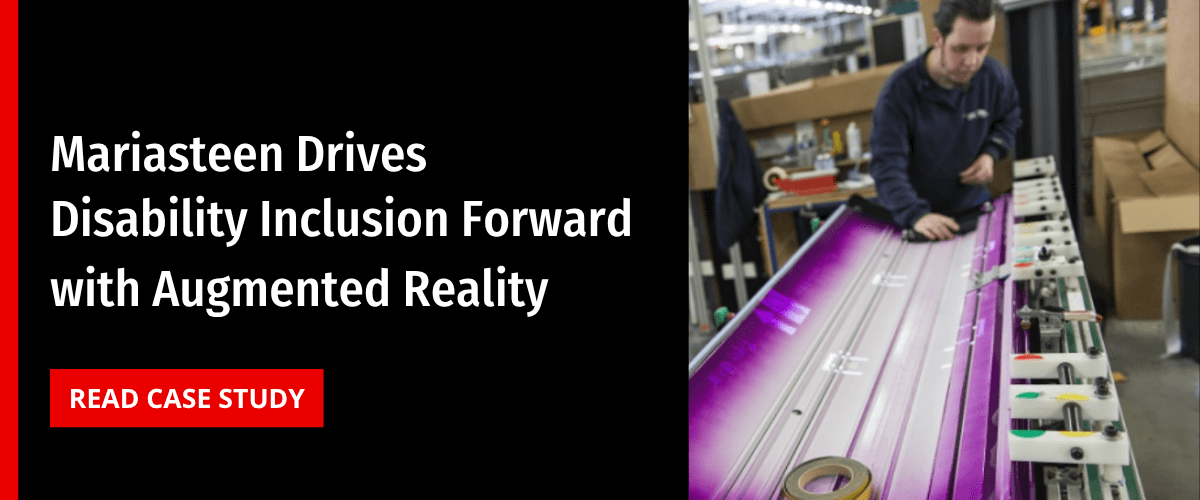
Case Study: Mariasteen, a Belgian manufacturer employing over 700 individuals with disabilities, offers a powerful example of what’s possible. With LightGuide’s projected augmented reality work instructions, employees perform complex tasks with greater ease and confidence. Since implementing LightGuide, the company has increased throughput by 50% and significantly reduced defects. Learn more, here.
A Day in the Life: The Augmented Connected Worker
Imagine if every worker had access to real-time guidance, essential data, and intelligent tools designed to make their work faster, safer, and more effective.
Augmented Intelligence in Manufacturing
Picture a typical shift in a high-mix manufacturing facility. Using AR for assembly, operators scan a product barcode to instantly load work instructions for that specific part number or product variation. Digital instructions are projected directly onto the work surface, guiding operators through each assembly step while AI-powered machine vision cameras verify accuracy in real time.
As operators move through their production queue, new variants are introduced, and the system automatically updates instructions, eliminating confusion, reducing changeover time, and ensuring every build follows the correct process.
RELATED ARTICLE: 6 Uses of Augmented Reality for Manufacturing in Every Industry
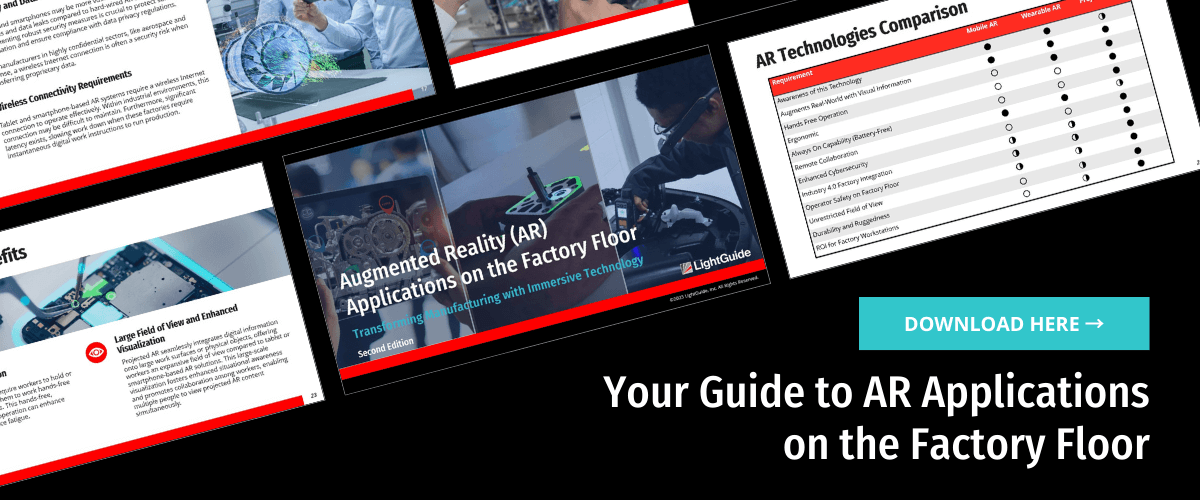
Augmented Intelligence for Data Center Operations
Now, consider a data center break-fix technician servicing a server rack. In these technical environments—where intricate cabling, sensitive equipment, and uptime demands leave little room for error—augmented intelligence delivers measurable value.
Instead of referencing a checklist or diagram, technicians receive hands-free visual guidance projected directly onto the equipment. Step by step, the system walks them through inspection, disassembly, repairs, and reinstallation. AI-driven logic detects anomalies, flags missing parts or cables, and prompts the system to deliver corrective actions. This creates a safer, more efficient, and error-resistant workflow for critical infrastructure maintenance.
RELATED CONTENT: Augmented Reality Solutions for Data Centers
Augmented Intelligence in Warehousing and Fulfillment
In warehousing and fulfillment environments, where speed, accuracy, and adaptability are critical, augmented intelligence is redefining how teams pick, pack, and ship orders.
Inside a busy distribution center, workers race against the clock to keep up with a steady flow of incoming orders. SKUs change constantly, packaging requirements vary, and one wrong pick can delay an entire shipment.
As workers move through the warehouse, AR guides them to the right location and highlights the exact item they need, along with order quantities and handling instructions. At the same time, AI-driven insights optimize routes and verify accuracy, ensuring every order is fulfilled quickly and correctly.
RELATED ARTICLE: Warehouse AR: How Augmented Reality is Transforming Logistics
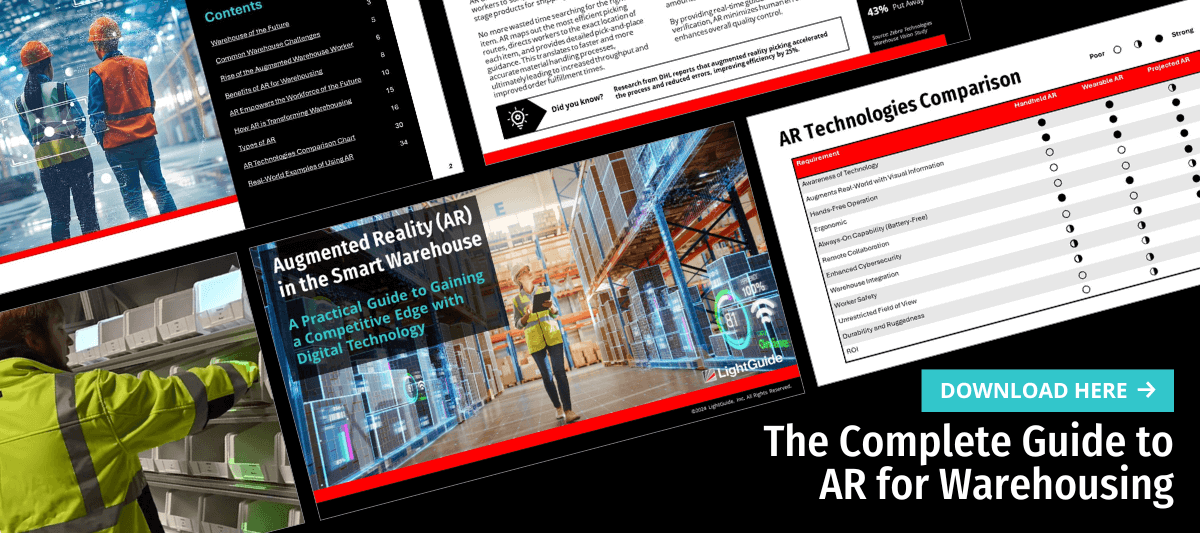
Across each of these environments, data is captured automatically, providing end-to-end traceability and insights that drive continuous improvement.
For workers, the experience feels empowering, not intrusive. Complex tasks become clearer, mistakes are caught before they cascade, and feedback is immediate. Confidence grows, engagement rises, and teams feel supported.
The result is a smarter, more connected workforce where augmented intelligence enhances human capabilities to drive productivity, quality, and engagement.
Augmented Intelligence: The Future of Frontline Work
The rise of augmented intelligence marks a turning point in workforce transformation. By combining human ability with intelligent connected worker technologies, manufacturers can unlock new levels of performance, adaptability, and engagement.
As companies look to build more resilient, future-ready operations, AR-enabled augmented intelligence offers a strategic path forward, bringing AI to life visually for frontline workers. It closes the gap between digital intelligence and physical execution, creating an augmented connected workforce that learns faster, works smarter, and drives continuous improvement.

Empower Your Frontline Teams with Augmented Intelligence
See LightGuide AR in Action